

4 table tennis benefits that improve pickleball
Discover how table tennis training for pickleball improves hand speed, spin recognition, touch, and decision-making on the court.
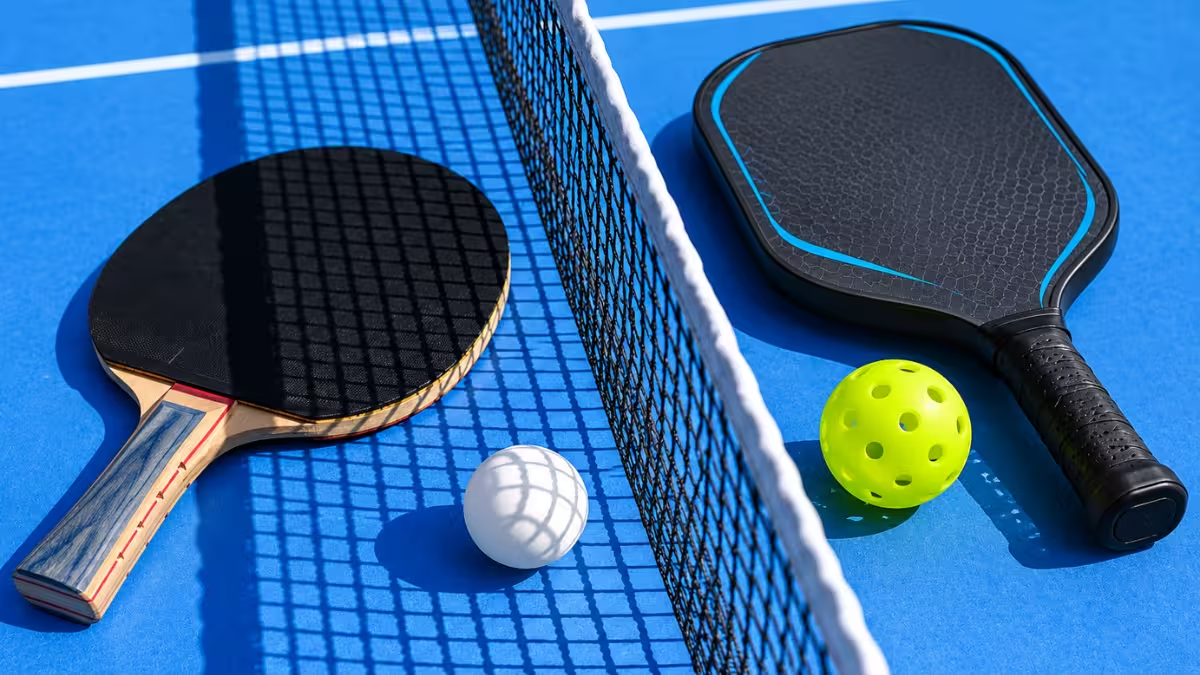
Many pickleball players reach a point where improvement starts to slow down.
You continue playing several times per week, but your hands don’t seem any faster, your resets remain inconsistent, and fast kitchen exchanges still feel uncomfortable. More court time helps, but simply playing games isn’t always the fastest way to improve.
One of the most overlooked tools for skill development is table tennis training for pickleball. While the two sports look very different at first glance, they share several important athletic and technical demands.
The players who understand these similarities often develop better reactions, touch, spin awareness, and decision-making much faster than those who rely solely on match play.
Why many pickleball players plateau despite playing regularly
Most recreational players spend the majority of their time playing games.
Games are enjoyable and important for learning strategy, but they do not always provide enough focused repetitions to develop specific skills.
This often leads to common frustrations such as:
- Slow hands during kitchen exchanges
- Difficulty reading spin
- Inconsistent resets
- Poor reaction time under pressure
- Hesitation during fast points
When these weaknesses persist, players often feel stuck between skill levels.
The good news is that some of these skills can be trained extremely effectively outside of pickleball itself.
Why table tennis training for pickleball works
Table tennis forces players to process information quickly.
The ball travels fast, spin influences every shot, and players must make split-second decisions while maintaining control.
These demands transfer surprisingly well to pickleball.
Both sports require:
- Hand-eye coordination
- Quick reactions
- Touch and feel
- Spin recognition
- Fast decision-making
While table tennis should never replace pickleball practice, it can serve as a valuable supplemental training tool.
Benefit #1: Faster hands at the kitchen line
One of the biggest benefits of table tennis is improved reaction speed.
How table tennis develops reaction speed
Table tennis rallies happen at an extremely fast pace.
Players constantly react to incoming shots while making small adjustments to paddle angle, contact point, and timing.
This repeated exposure trains the nervous system to process visual information more efficiently.
One of the biggest reasons table tennis transfers well to pickleball is the emphasis on reaction speed. This video demonstrates how table tennis players train their ability to recognize and respond to incoming shots quickly, a skill that directly applies to fast exchanges at the kitchen line.
Applying it to pickleball hand battles
Kitchen exchanges often come down to fractions of a second.
Players who have developed faster reactions through table tennis frequently feel more comfortable during speedups and hand battles.
Instead of feeling rushed, they can recognize incoming balls sooner and react with the right shot selection, which leads to greater confidence.
Benefit #2: Better spin recognition
Many intermediate pickleball players struggle because they misread spin on the ball, or lack thereof.
The result is often a pop-up, mishit, or miscalculation of movement
Reading spin earlier
In table tennis, spin is impossible to ignore.
Every serve and rally ball contains some form of spin, forcing players to constantly identify ball rotation and adjust accordingly.
Over time, players become much better at recognizing visual cues.
Handling topspin, sidespin, and slice more effectively
While pickleball produces less extreme spin than table tennis, the same principles apply.
Players who improve spin recognition often:
- Return serves more consistently
- Handle drives more effectively
- Adjust paddle angles sooner
- Can move their body to the ball sooner.
This skill becomes increasingly valuable as paddle technology continues to generate more spin in modern pickleball.
Benefit #3: Paddle plane awareness and ball control
Power attracts attention, but touch wins a lot of points.
Many intermediate players lose rallies because they struggle with resets and soft shots.
Developing softer hands
Table tennis rewards precision.
Small adjustments in paddle angle and swing path can dramatically change the result of a shot.
This develops greater awareness of the plane of the paddle upon contact with the incoming ball and the stability of the swing after contact—a critical skill in both sports.
Better resets and dinks
The ability to adjust to the pace is one of the most important skills in pickleball.
Players who spend time developing touch through table tennis often find that their resets become more controlled and their dinks become more consistent.
Instead of fighting the ball, they learn how to guide and redirect it.
Benefit #4: Quicker decision-making under pressure
Physical skill is only part of the equation.
The best players also anticipate and make good decisions quickly.
Learning to process information faster
Table tennis creates constant pressure.
Players must evaluate speed, spin, placement, and strategy within fractions of a second.
This improves information processing and anticipation.
Making smarter choices during fast exchanges
In pickleball, hesitation often leads to mistakes.
Players who can process information faster tend to:
- Recognize attack opportunities earlier
- Defend speedups more effectively
- Anticipate opponents’ intentions
- Make cleaner decisions under pressure
The game begins to feel slower because the brain is processing information more efficiently.
How to incorporate table tennis into your pickleball training
You do not need to become a competitive table tennis player to gain benefits.
Even occasional sessions can help develop transferable skills.
Consider using table tennis for:
- Reaction training
- Spin recognition practice
- Touch development
- Hand-eye coordination work
- A way to improve resets and counters
The goal is not to replace pickleball practice.
The goal is to supplement it.
Many players find that a small amount of cross-training helps accelerate their development on the pickleball court, particularly when they combine it with a structured approach to practice and skill development.
The key is to focus on transferable skills such as hand speed, spin awareness, touch, and decision-making rather than treating table tennis as a replacement for on-court pickleball training.
Conclusion
Table tennis and pickleball are different sports, but they share several important performance demands.
Table tennis training for pickleball can help improve:
- Hand speed
- Spin recognition
- Ball control
- Decision-making
These are all skills that directly influence performance during real matches.
If you’re looking for a way to accelerate your development beyond simply playing more games, adding occasional table tennis sessions or videos may be worth exploring.
The players who improve fastest are often the ones who find creative ways to develop skills outside of match play.


Train smarter and improve faster
Access technique breakdowns, drills, skill progressions, and coaching resources.
Get free weekly coaching tips
Receive weekly coaching tips, updates on class schedules, product news, and more.
