

How to anticipate speedups in pickleball
Learn how to anticipate speedups in pickleball, read your opponent, and defend confidently. Actionable drills, mistakes to avoid, and skill progression tips.
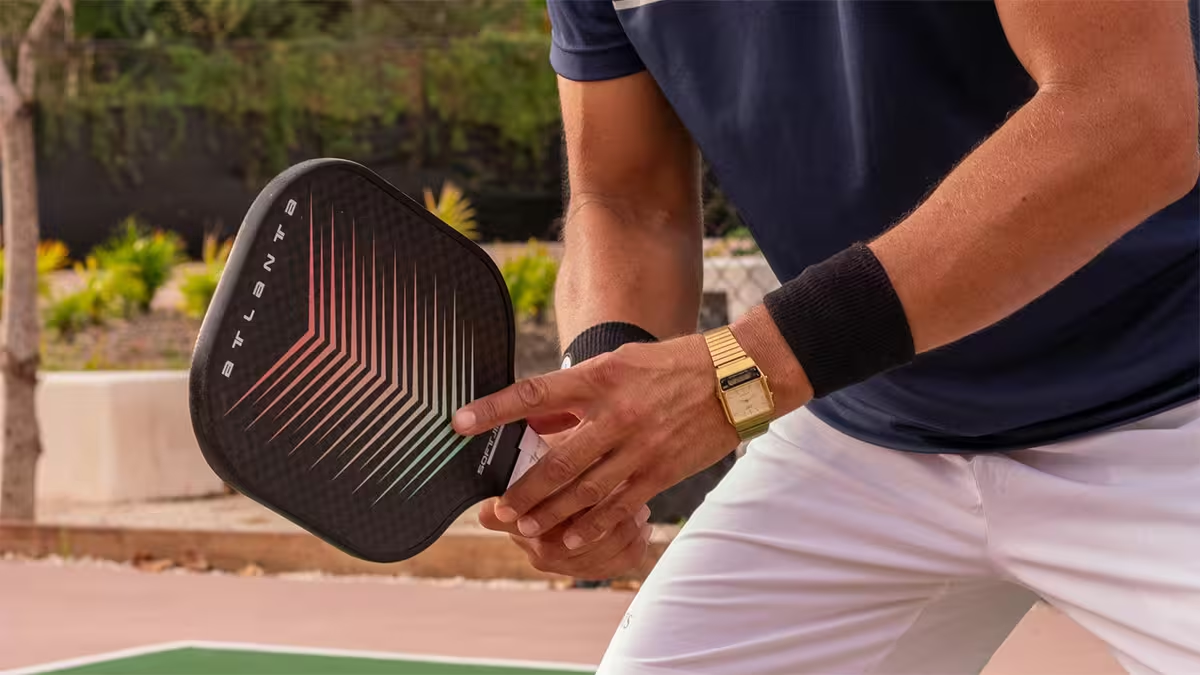
If you play pickleball, you’ve likely experienced the moment when an opponent suddenly speeds up the ball at the kitchen line.
For many players, these shots feel unexpected and difficult to handle. Even when you are in position, the pace change can make the ball feel faster than it actually is.
The instinct is to rely on reaction speed. But at the 2.5–3.5 level, the issue is rarely reaction time alone. It is anticipation.
You may have experienced the feeling of not knowing when or where the opponent when the opponent is going to speed up the ball.
Fear no more—in this post, I’ll tell how exactly how to read it and prepare for it so you’re ready for the counter.
Learning how to anticipate speedups allows you to prepare earlier, stay balanced, and hit aggressive counter volleys. Instead of reacting late, you begin to recognize when an attack is likely to happen.
Why speedups catch most players off guard
It’s common to feel in control when the rally is slow and consistent. Dink exchanges feel predictable, and you have time to think between shots.
There are a few reasons this happens:
- Most players focus only on tracking the ball, ignoring body cues from their opponent
- Paddle and court position are often not ready for a fast exchange
- Standing right behind the kitchen line provides very little time to react
- Speedups feel random because there is no anticipation
As a result, points often break down quickly. Even a single speedup can end the rally.
Why does this keep happening?
1. Below the 4.0 level, most players are ball-focused
They watch where the ball is going, but not what the opponent is doing before contact. Because of this, every speedup feels sudden.
2. Lack of pattern recognition
Certain types of balls are more likely to be attacked. For example, a ball that is at hip height or is further from the net is easier to speed up. A ball that is hit when the opponent is scrambling or reaching for the ball is harder to speed up and therefore less likely to occur. If you do not recognize these situations, you will always be reacting late.
3. Paddle positioning also plays a big role
If your paddle is below your hip or your stance is upright, you are not prepared for a faster shot. Even if you see it coming, you may not be ready to handle it.
4. Not enough drilling
In games, speedups happen randomly. Without repetition, it is difficult to improve your response or develop consistent habits. Drilling isn't simply hitting for hours on end either. It takes the right awareness and intention.
You can learn more from our guide about how to drill properly in pickleball.
The correct approach
Handling speedups effectively starts with shifting from watching the ball to watching your opponent and their paddle.
1. Read your opponent, not just the ball
Assume every ball will be a speedup, and assume it will be hit to you!
After every shot you or your partner hit at the kitchen, you should run this checklist through your mind:
- Is my shot high or low?
- Will it bounce in the kitchen?
- Is my opponent shuffling their feet and taking a big back swing?
- Is there a pause in their swing before they hit?
If the first 3 items check off, a speed-up is highly probable. Remember, at the kitchen, you should always be identifying the technique difference between a dink vs a speedup!
2. Improve your ready position
Once you’ve anticipated an incoming speedup, let’s prepare your body. Your ready position determines how well you receive the fast ball.
Small adjustments make all the difference between reacting defensively and confidently being offensive.
- Keep your paddle in front at chest height
- Stay slightly bent at the knees with your weight forward
- Position your body directly across your opponent and be prepared to counter the speedup using your backhand
Why? The backhand is easier and quicker to reload and defend shots aimed into the body.
When your body and paddle are in the right place at the right time, you will be twice as fast to react, and you’ll be able to counter the ball with more control.
Bonus tip: also notice if your opponent is hitting from their backhand or forehand side. That will inform if you can expect the ball to come to your forehand or backhand as well.
If opponent hits a backhand speedup (right-handed player), you can look for the next ball to be in the vicinity of your forehand/body (if also right-handed).
Are these hard rules? No. But they are repetitive clues that can increase your chances at being ready.
If you’re not sure whether your positioning or habits are causing issues in these moments, private pickleball lessons in the Bay Area can help identify what is breaking down and provide more specific adjustments.
3. Recognize high-risk situations
Not every ball is likely to be sped up. Learning when to expect an attack is a key part of anticipation.
In addition to the mental checklist, you should always be aware of the following:
- The height of the opponent’s contact point
- Your shot or your teammate’s shot is slow-paced and hit in front of the opponent
- Your opponent looks balanced and is not pressured
- The pace of the rally—are players scrambling due to faster balls, or is everyone more stationary and not moving much?
The quicker you become at recognizing these scenarios and body positions, the faster you can train your reflexes to take proper, decisive action.
Check out this quick video on recognizing the visual triggers.
Drills to practice anticipation
Anticipation improves with repetition and awareness. The goal is to train your ability to recognize cues and prepare early.
Drill 1: Tell-tale partner drill
Setup:
Stand at the kitchen line with a partner.
Execution:
Your partner alternates between a dink and a speedup, and hits to one side at a time, e.g., forehand only for round 1, then backhand.
Focus on their paddle and body position before each shot, and move your paddle in the right position to block the shot, NOT swing to hit it back.
You want to imagine being a wall and bounce the ball back by being still with the paddle.
Objective:
Get in the habit of recognizing visual cues and moving the paddle in the right position without panicking.
Drill 2: Dink-dink-speedup
Setup:
Stand straight across your hitting partner at the kitchen line.
Execution:
Counting the feed, hit 2 dinks in the rally, then on the third ball, the ball feeder hits a speedup while the other player hits a reset volley by just moving the paddle in the right position to make clean contact with the ball.
Tip: To take the drill up another level, instead of resetting, counter-volley the speedup and play out the point.
Objective:
Improve resets, counters, visual recognition, and hand-eye coordination.
Common mistakes to avoid
- Waiting until after the opponent hits the ball to react
- Watching only the ball instead of the opponent
- Letting your paddle drop below the hip
- Not imagining that every ball will be hit fast
These habits reinforce reactive play instead of anticipatory play.
Skill level notes
At the 3.0 level, players are mostly reactive. Speedups feel sudden and difficult to predict.
At the 3.5 level, players begin to recognize patterns but are inconsistent in hitting the ball successfully, whether through a reset or an offensive counter.
At the 4.0+ level, players anticipate before contact. They are ready based on positioning, ball quality, and opponent cues.
Improving anticipation helps bridge the gap between these levels.
Conclusion
Anticipating speedups is not about reacting faster. It comes from recognizing patterns, preparing earlier, and staying in control of your positioning.
By paying attention to your opponent’s cues, improving your ready position, and practicing these situations intentionally, you can handle faster exchanges without feeling rushed.
If you want ongoing guidance, drills, and examples of how to train these situations consistently, the Skool community provides a structured environment to continue improving over time.


Build better anticipation on the court
Follow a clear structure for what to work on and improve your decision-making in fast situations.

Get free weekly coaching tips
Receive weekly coaching tips, updates on class schedules, product news, and more.
