

How to drill correctly in pickleball
Learn the difference between purposeful pickleball drilling and random hitting and how it impacts your ability to make meaningful improvement.
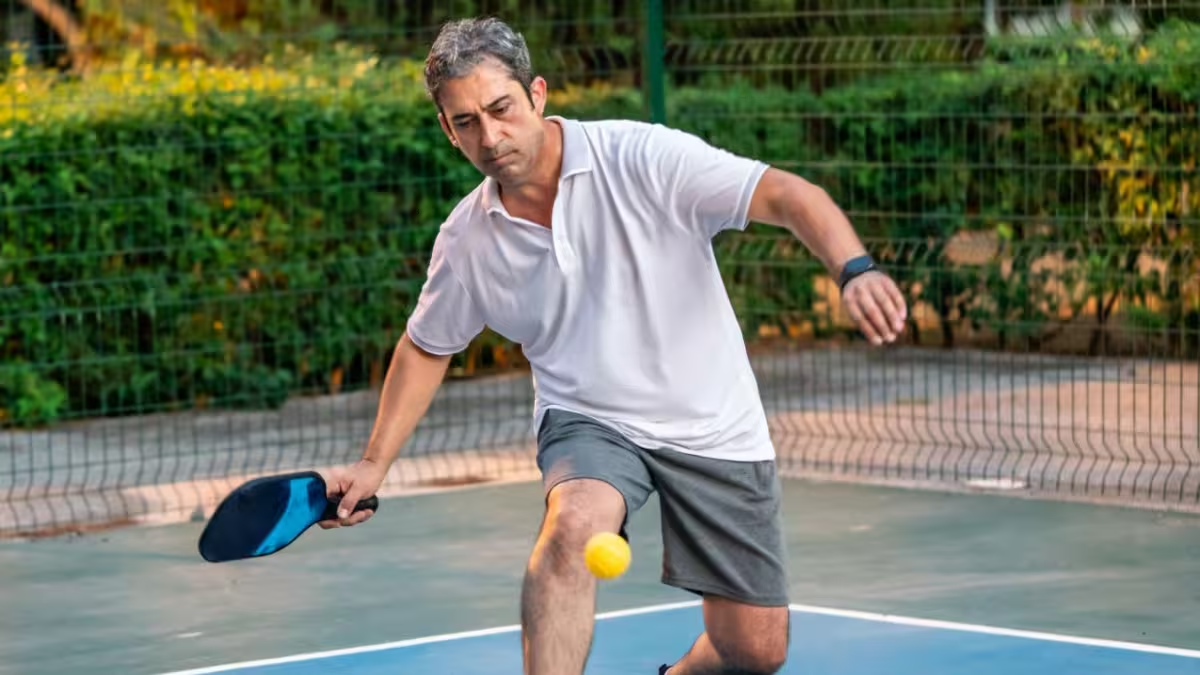
Drilling is the most effective way to improve at pickleball, yet most players never fully benefit from it, let alone do it at all.
If you’re trying to get better, you’ve likely heard that you need to drill more.
But for most players, the issue is not a lack of effort. It is how that effort is being applied.
Many recreational players spend time hitting balls back and forth and assume that counts as practice. It feels productive because you are active, but it rarely leads to consistent improvement.
If your goal is to improve your game, not just stay active, your drilling needs to be focused, structured, and progressive.
Why most pickleball drilling doesn’t work
Many players don’t actually like drilling at all and therefore neglect it. For the ones that do, they approach it the same way they approach games.
They rally casually, switch between different shots, and move from one drill to another without spending enough time on any single skill. This is considered warming up, not drilling.
This creates a few common problems:
- No clear focus during practice
- Not enough repetitions of one skill to build muscle
- Pace that is too fast to maintain control
- No feedback on what is actually happening or what needs to happen
Without these elements, drilling becomes similar to playing. It’s random, and you are not building consistency or control.
For players who feel stuck at the same level, this is often the reason.
There’s also another big hidden reason—many players don’t have access to a consistent or high-level drill partner (4.0+) who’s able to hit a high volume of shots accurately.
What effective pickleball drilling looks like
Effective drilling is not complicated, but it does require structure. When building a skill, you first want to develop consistency, then accuracy, then power.
Clear skill focus
The most productive drilling sessions focus on one to two skills at a time.
Instead of switching between dinks, volleys, and other shots, you stay with one specific skill long enough to build consistency.
This allows you to develop muscle memory and understand what correct execution feels like.
- Choose one skill per 20 or 30 min
- Practice that skill only for the session duration
- Understand the correct and incorrect ways to perform the skill so you can self-diagnose
You want to avoid random hitting without being aware of what aspect you want to improve, e.g., timing, balance, power, accuracy, etc.
Controlled pace and intensity
Many players rush through drills.
They try to match game speed too early, which leads to inconsistent contact and repeated mistakes.
Slowing down your pace allows you to focus on technique and make adjustments more effectively.
- Start at a speed where you can maintain control
- Increase intensity only after achieving consistency
- Prioritize consistency and accuracy over power
This is where most players begin to see improvement, because they are no longer reinforcing mistakes at a high speed.
Purposeful feedback and adjustment
Drilling only works if you experiment and discover new body mechanics .
If the ball consistently goes too high, too low, or off target, something in your technique or positioning needs to change.
Without feedback, the same mistakes repeat.
- Use targets to improve accuracy
- Ask your partner for observations
- Adjust one variable at a time (e.g. paddle contact angle) then test it immediately and see the result it gives you.
This process helps you understand not just what is happening, but why.
How to structure your drilling sessions
Drilling does not need to be complex to be effective.
A simple structure allows you to stay consistent and focused.
Example 30-minute: Backhand crosscourt slice dinks
Hit only cross-court backhand dinks with a partner.
Focus on:
- Keeping the ball low and landing 12” in front of the kitchen line
- Maintaining consistent contact in front of the body
- Keeping the wrist fixed throughout contact and the paddle angle facing your opponent
Staying with one skill for the entire session builds muscle memory and confidence to the point where the shots hit in the game will feel just like the drill.
It is recommended to drill at least 40–60 min a week on one to two skills.
Drills you can use immediately
Volley reflex drill
Setup:
Stand 6” inside the kitchen line with a partner.
Objective:
Improve reflexes with micro movements when swinging between forehands and backhands.
Execution:
Use a short, compact swing and direct the ball with control.
Third shot drop repetition
Setup:
One player at the baseline, one at the kitchen. Alternate roles.
Objective:
Develop consistency on third shot drops.
Execution:
From the baseline, repeat drops from one side at a time, one spin at a time. Focus on footwork and ball contact timing.
Avoiding common mistakes in pickleball drilling
Even players who drill regularly can develop habits that limit progress.
- Changing drills too quickly before mastering a skill
- Practicing at game speed instead of controlled practice speed
- Focusing only on rallying without focus
- Not understanding the correct technique
Fixing these issues often leads to faster improvement than adding more drills.
How structured drilling leads to better play
Pickleball has a wide range of skills, and not every skill should be practiced at every stage of development.
The fastest way to improve is by focusing on the skills that are most important for a player’s current level. Once those skills become consistent and reliable, the next layer of skills can be added on top.
That progression is what builds complete players.
To help simplify the process, I’ve developed a Skill Progression System that outlines:
- The key skills players should focus on at each level
- What to prioritize first versus later
- Recommended drills designed to develop each specific skill
Instead of guessing what to work on next, players can follow a clear progression path that builds the right fundamentals in the right order. To see how it works, visit this page.
Conclusion
Drilling correctly is one of the most effective ways to improve in pickleball. The secret to success is:
- Committing to drilling at least 1–2x a week
- Practicing one skill at a time until you gain confidence
- Being aware of your body mechanics
- Getting enough volume of repetitions
The more you can repeat this procedure each week, the faster you can build consistency that carries into your games. Remember, the pros drill 75% of the time, and you should be too!
All players can improve, they just have to want it bad enough and be intentional about it.


Ready to upgrade your drilling?
Join the Skool community or explore our Skill Progression system for step-by-step guidance, feedback, and a clear path to improvement.

Get free weekly coaching tips
Receive weekly coaching tips, updates on class schedules, product news, and more.
