

Footwork in pickleball: Why it matters
Learn why footwork in pickleball affects your control, consistency, and ability to execute shots under pressure.
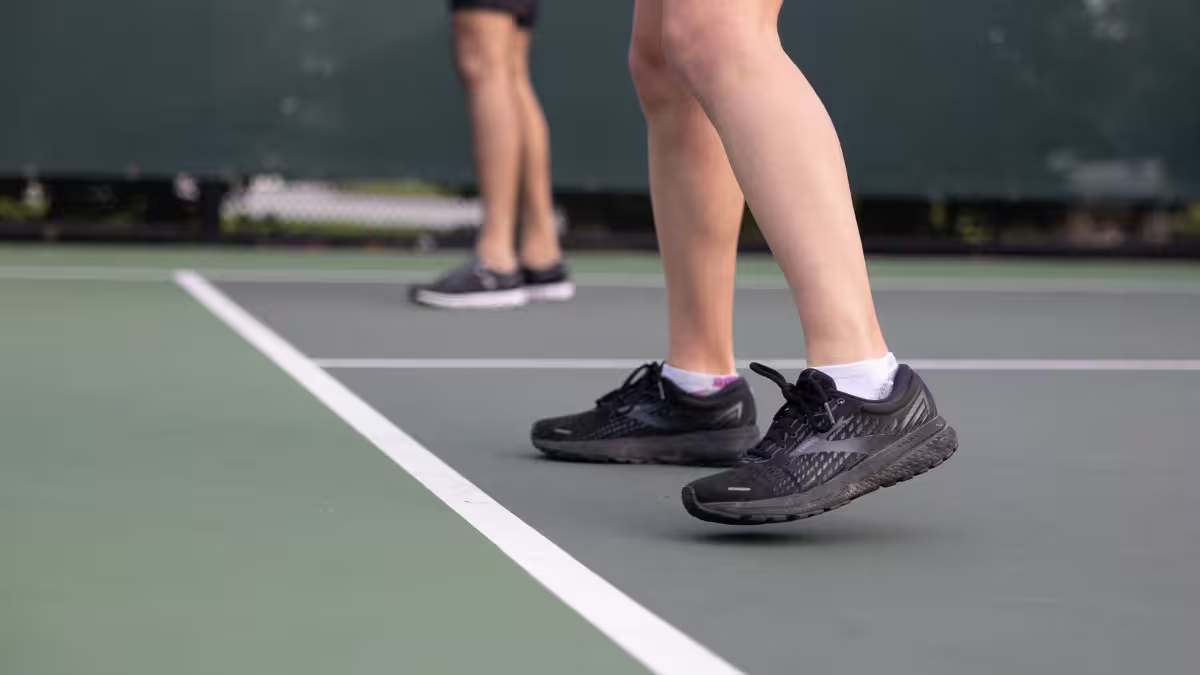
If you’re trying to improve your game, it’s easy to focus on your swing, paddle angle, or shot selection.
But in many cases, those are not the real issue.
The issue is footwork in pickleball.
At the 2.5–3.5 level, players usually know what shot they want to hit. The problem is that they are not in the right position to execute it. When that happens, even simple shots become difficult to control.
This is why footwork in pickleball is one of the biggest factors in consistency and shot quality.
Why proper footwork in pickleball improves consistency
Most unforced errors don’t come from a lack of technique. They come from being out of position or imbalanced.
If you arrive late to the ball, you rush your swing. When you rush, your contact point becomes unstable, and the paddle angle is harder to control.
Balance is another issue.
If your feet are still moving when you hit the ball, your body is not stable. Even if your mechanics are correct, the result will be inconsistent because your base is not set.
A common habit at beginner and intermediate levels is reaching.
Instead of moving their feet, players extend their arms to reach the ball. This reduces control and makes it harder to direct the shot.
These mistakes are not random. They come from movement patterns that haven’t been trained.
What proper footwork in pickleball actually looks like
Good footwork in pickleball is not about speed. It is about positioning, timing, and control.
Getting set before contact
The priority is to get into position early and be balanced before you hit the ball.
When your feet are set, your body is stable. This makes it easier to control direction and pace.
A simple guideline is this: your feet should be set before your paddle makes contact.
Moving early instead of reacting late
Many players wait too long to move.
They track the ball, let the ball bounce, then initiate their swing. That delay forces rushed movement.
Instead, movement should start as soon as you recognize where the ball is going. Early movement gives you more time to adjust and stay balanced.
The correct thing to do—perform a unit turn: the early rotation of your shoulders and upper body as soon as you recognize where the ball is going.
Once this is done, you can then move to the ball and be prepared to accelerate when the ball bounces, not after.
Another common issue with beginner and intermediate players is hesitation.
Players track the ball but delay their first step. That hesitation forces them to cover more distance in less time, which leads to rushed positioning.
Stronger players don’t wait for confirmation. They begin moving as soon as they recognize the direction of the ball. Even a small early step allows them to be one step ahead of the ball instead of reacting late.
This is what creates the feeling of having more time, even when the pace of the rally increases.
Maintaining balance through the shot
Control comes, and stability enables consistency.
If your weight shifts too far or your body drifts in the wrong direction, your contact point changes. That leads to inconsistency.
Focus on staying centered and stable before you hit each ball, especially during faster exchanges at the kitchen.
Using small adjustments instead of large steps
Pickleball footwork is made up of small movements.
You don’t need large steps to get into position. Most of the time, small adjustments are enough to stay aligned with the ball. Think like a dancer; “quick, quick, slow”. Move quickly to the ball so you can slow down and focus on a steady swing.
Large movements often slow you down and make recovery harder.
Video breakdown: Learning footwork at the baseline
Watch this example to see how to have proper footwork at the baseline:
In this video, I demonstrate how to use shuffle steps at the baseline, and I talk through my own footwork so you can follow along. Watch for the way I position myself and prepare for each shot. Pay attention to how I position early and set my feet before contact—those details directly impact consistency.
This is what allows players to stay consistent, even under pressure.
I provide more structured breakdowns like this, along with step-by-step drills and full technique courses, those are available inside the Skool community.
Footwork drills in pickleball
Shadow movement drill
Setup:
Stand at the kitchen line without a ball.
Objective:
Improve movement patterns and positioning.
Execution:
Move between forehand and backhand positions without hitting a ball. The movement will consist of shuffling your feet laterally, without crossing them over one another. Focus on getting your feet set quickly and staying balanced. Your chest should stay facing the net.
Controlled lateral movement drill
Setup:
Work with a partner at the kitchen line without a paddle.
Objective:
Improve side-to-side movement and recovery.
Execution:
Have a partner alternate shots to your forehand and backhand while you focus on shuffling to the ball early, getting balanced, and setting your feet. Just catch the ball and toss it back—no need for a paddle until you are accurate with moving and catching.
Once this becomes easy, have your partner hit randomly while you catch, then after several minutes, grab your paddle and rally back and forth.
Why these drills matter
These drills may seem simple, but they directly build the movement patterns needed during real points.
The goal is not speed, but control. As your movement becomes more efficient, you will notice that you arrive earlier at the ball and feel more balanced during contact.
Over time, this translates into more consistent shots and better decision-making under pressure.
Common mistakes with pickleball footwork
- Reaching instead of moving into position
- Leaning over and bending at the waist, which affects balance
- Taking steps that are too large and slow
- Moving after the ball bounces, instead of moving before the bounce
These mistakes often happen because players rely on instinct instead of trained movement patterns.
How footwork in pickleball affects different levels
At the 2.5 level, players are still working on getting into position consistently.
At 3.0, movement becomes more intentional, but timing is still inconsistent.
At 3.5, players start to position themselves earlier and maintain balance through contact. This allows them to control rallies and reduce unforced errors.
At lower levels, I also see players are still moving when they hit the ball. This is a big root cause for why they struggle with consistency.
At higher levels, players are set before contact more consistently. This allows them to control direction, pace, and placement with less effort.
As this improves, players begin to feel more in control during rallies instead of reacting under pressure.
Without reliable footwork, it’s difficult to improve consistency or handle faster points.
For players who want faster improvement on footwork, working through private pickleball lessons in the Bay Area can help identify movement issues and correct them with direct feedback.
Conclusion
Footwork in pickleball directly affects your ability to control the ball.
If you’re often off-balance, late to the ball, or relying on your arm to adjust, your consistency will be limited.
Better shot quality and consistency come from:
- Moving early
- Getting set before contact
- Using small, controlled steps
When your positioning improves, everything else becomes easier.
If you want to learn proper footwork for all areas of the court, I go over this in depth in my Skool community. Inside, you’ll also find detailed technique breakdowns to help you improve step by step.


Improve your footwork in pickleball
Get access to my Footwork Fundamentals course and improve your footwork in all areas of the court.

Get free weekly coaching tips
Receive weekly coaching tips, updates on class schedules, product news, and more.
